Faster code should mean faster delivery. It doesn't.
AI agents changed how fast teams write code. The process around that code mostly stayed where it was.
Anthropic's Claude Academy recently published a course, The AI-native SDLC playbook, that starts from this gap. Its argument:
- Many engineering teams still run the same approval gates, reviews, handoffs and policies as before.
- Those gates stall the gains from agentic coding tools like Claude Code.
These are my notes on the introduction, plus what I changed when I applied it to a small team.
TL;DR
- Agents made the build stage fast. Planning, review and release still run at human speed, so they are the new bottleneck.
- The course keeps the old controls and enforces them differently: a committed artifact at every stage, and gates that fire automatically.
- Six of the twelve plays have no prerequisites, so you can start small.
- On a small team with no product owner, the same loop works if the developer who owns the work signs off on each artifact.
The traditional SDLC was built around expensive code
The software development lifecycle (SDLC) is the process that takes software from idea to production.
Most organizations run some version of six stages: plan, design, build, test, deploy and maintain. Each stage is a discrete phase owned by a different role:
- Product managers write requirements.
- Architects turn them into designs.
- Engineers build.
- QA verifies at regulated enterprises.
- Release teams ship.
- Operations monitors what runs.
Work moves between phases through documents, tickets and sign-offs.
The structure is process-heavy on purpose. It gives accountability and control at each step.
It was also designed for an era when writing code was the slowest and most expensive stage. Product requirements documents, estimation rituals and product security reviews existed to force alignment across weeks, months or quarters of development.
The controls assume that a human performs every step.
What changes when build runs at agent speed
Once the build phase outruns the traditional process, the course points to three consequences:
- The bottleneck moves. The slow points become the stages on either side of build: planning and review, testing and deploy. They still run at human speed.
- Controls stop matching reality. Reviewing every line by hand made sense when a person wrote it. It can't keep up once agents write most of the diff.
- Governance costs rise. Exceptions still route through meetings and committees that convene weekly or monthly.
The course uses security as its example. Security teams are sized for human output. Agents multiply code output, so one of two things happens:
- The review queue grows.
- Code ships under-reviewed.
A regulated organization can accept neither. Its security and policy checks must keep pace with the agents.
To get the productivity gains of agentic AI without giving up security, the rest of the lifecycle needs the same overhaul the build phase has already had.
DORA, Google's long-running research program on software delivery, points the same way. Its 2025 report on AI-assisted development says:
- AI's primary role is as an amplifier, magnifying an organization's existing strengths and weaknesses.
- The greatest returns come not from the tools themselves, but from a strategic focus on the underlying organizational system.
That fits the course's claim: the tool is the easy part, and the process around it decides the result.
The AI-native SDLC: a loop, not a line
The course keeps the old control objectives but changes how they are enforced.
The linear flow becomes a continuous loop with AI at every stage. Humans stay above the loop to start, direct and govern the work. Handovers between stages are automated and trigger the next step, so the manual handoffs of the traditional model go away.
A committed artifact ties the loop together. Each stage ends by committing one to version control, and the next stage starts by reading it:
intent.md,spec.mdandplan.mdin the early stages- the diff and its tests
- the pull request with its review findings
- the incident record
In the early stages the main artifact is a Markdown file, because a product owner and an agent can both read and act on the same file. From build onward, the artifact is code and its records.
The chain of commits also becomes the audit trail. It records:
- who asked for what
- what the agent produced
- who approved it
Humans stay accountable for every decision that requires judgment. Their attention shifts to reviewing the artifacts at the gates.
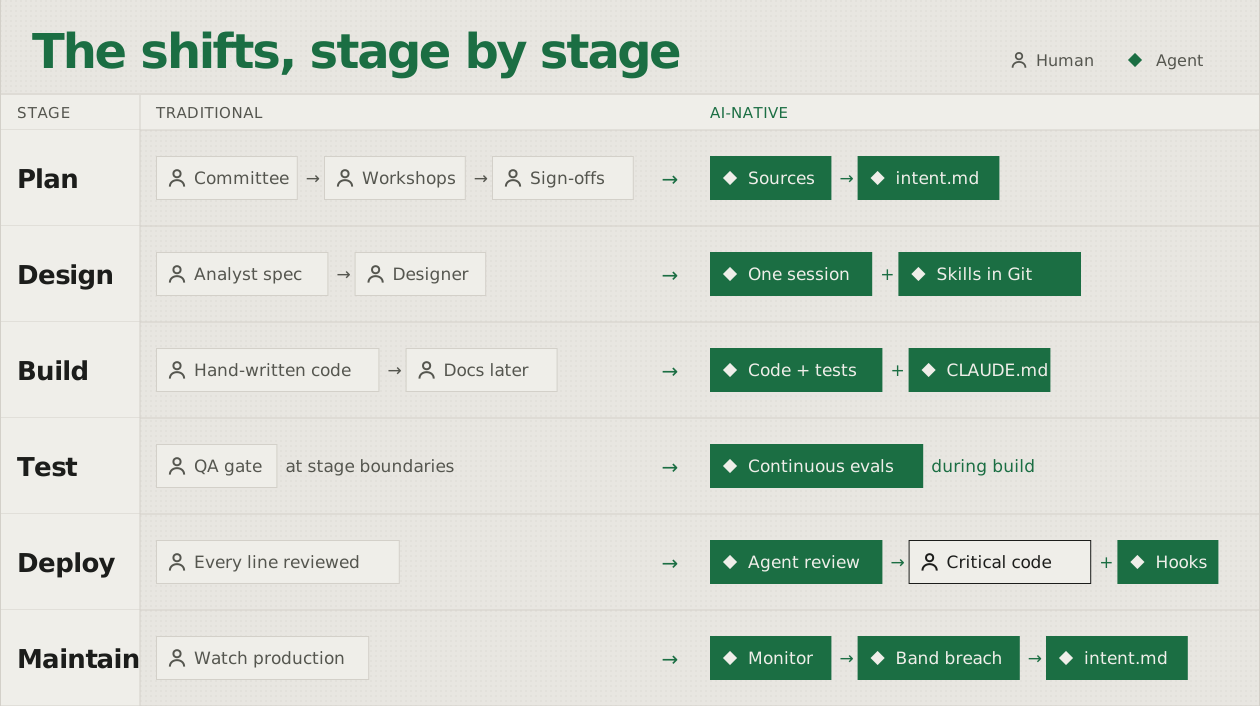
The shifts, stage by stage
Most organizations sit somewhere between the two columns.
How the playbook is organized
The rest of the course is built from twelve "plays", grouped under the six stages. Each play covers:
- what changes
- how to get started
- concrete implementation steps
- governance considerations
- how to measure whether it worked
The plays are modular, so an organization can transform different stages at different times. Each one names its dependencies under "Prerequisites."
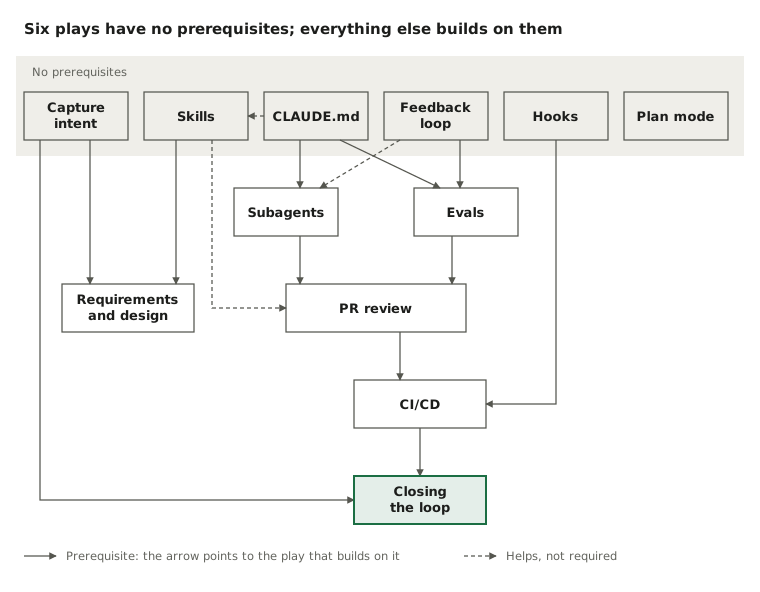
Solid arrows lead to a play that builds on the one at the tail. Dashed arrows mark a play that helps but is not required.
A stage ends by committing an artifact, and that commit starts the next stage:
- An accepted
intent.mdtriggers the requirements and design pass. - An approved
spec.mdtriggers plan mode. - A merged pull request triggers the pipeline.
- A breached control band in production writes the next
intent.md, and the loop continues.
At first, you prompt each step by hand. The end state is a loop in which each accepted artifact fires the next gate. Human attention concentrates at those gates, reviewing what the agent flagged instead of starting each stage from scratch.
What I changed for a small team
The course assumes a product owner who accepts intent.md and approves spec.md. On a small team, that person often doesn't exist for developer docs. And a gate nobody staffs just stalls the loop.
So I'm turning the early plays into Claude Code skills for my own projects: init, capture-intent, requirements-and-design and plan. The biggest change is who approves. The developer who owns the work reviews each artifact and confirms it. That confirmation is the only sign-off.
I kept the parts that make the artifacts useful:
- numbered requirements in
spec.md, so the plan and the review can cite them - flagged areas of concern, each with an owner who should decide
- a
plan.mdthat names the files, the order of work, the risks and the tests
A small config file, written once by init, records where artifacts live and whether the intent comes from GitHub, Linear or Jira.
I dropped what only matters at scale:
- the CI trigger on accepted intents
- the escalation to a tech lead
- the metrics
This is my opinion, not a result: the sign-off matters more than the role that gives it. A named person who confirms each artifact keeps the audit trail. A committee nobody has time to convene doesn't.
Takeaways
Faster code generation doesn't speed up delivery if planning, review and release still run at human speed. This is the claim from the introduction that I'd bring to a team discussion.
The proposed fix keeps the same controls and enforces them differently:
- Artifacts are committed at every stage.
- Gates fire automatically.
- Hooks apply policy as the agent acts.
- Layered agentic review reserves human attention for regulated and critical code.
If you want to start, the dependency structure shows where. Six plays have no prerequisites:
- capturing intent
CLAUDE.md- skills
- a feedback loop
- hooks
- plan mode
Everything else builds on those.
Sources
- Introduction, The AI-native SDLC playbook, Claude Academy, read November 2, 2026.
- 2025 DORA State of AI-assisted Software Development, overview, read November 2, 2026.